Marranos, Conversos & Anusim
What do marrano, converso, and anusim mean? The history of Spain and Portugal's forced Jewish converts who kept their faith in secret for centuries.
«Marrano,» «converso,» «New Christian,» «anusim» — four words for one of history's quietest survival stories: the Jews of Spain and Portugal who were forced to become Christians, and the descendants who carried a hidden thread of identity across five centuries. The terms overlap, but they are not the same, and the difference matters.
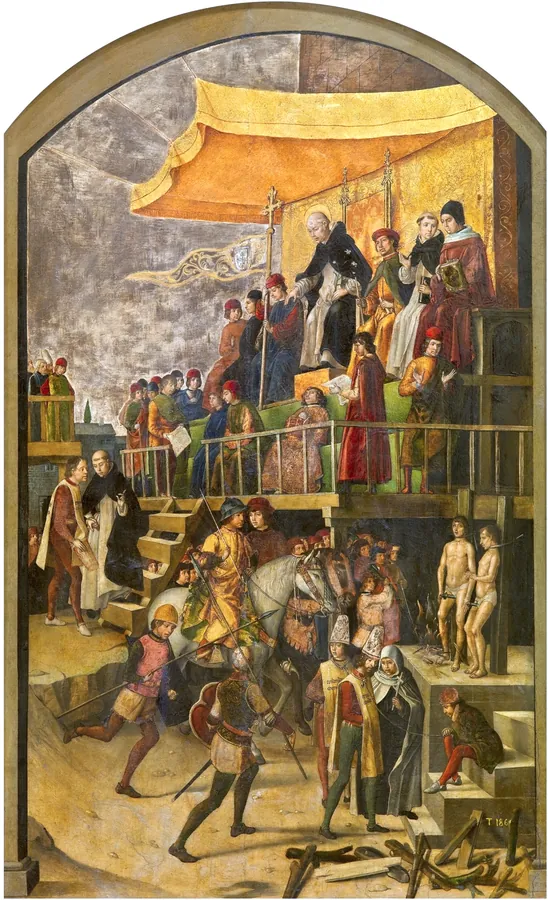
What does «marrano» mean?
«Marrano» is the oldest and most loaded of these words. In medieval Spanish it meant «swine,» and it was hurled as an insult at Jewish converts suspected of secretly keeping their old faith. Scholars still debate its exact origin — some trace it to the Arabic muharram («forbidden»), others to the plain Castilian for pig, an unmistakable jab at people accused of only pretending to eat pork. Whatever its root, the word began as a slur. Historians use it as a technical label for the crypto-Jews of Iberia, but many descendants understandably prefer converso or the Hebrew anusim. On this site we use «marrano» only because people search for it — never as a name for a person.
Conversos and New Christians
The story begins before the famous expulsion. In 1391, waves of anti-Jewish violence swept Castile and Aragon, and tens of thousands of Jews were baptized under threat of death. These first converts, and the far larger number who followed, became known as conversos or cristianos nuevos — «New Christians,» as opposed to the «Old Christians» who claimed no Jewish or Muslim ancestry.
The rupture came in 1492, when the Alhambra Decree gave the Jews of Spain a stark choice: convert or leave. Those who stayed joined the ranks of the conversos. Five years later, in 1497, Portugal went further — rather than expel its Jews (many of them recent refugees from Spain), the crown ordered a forced mass conversion, baptizing an entire community almost overnight. That is why so many ordinary Portuguese family names appear among those of converso origin, a thread we follow on our Sephardic surnames page.
Anusim and B'nei Anusim
Anusim is Hebrew for «the forced ones.» It is a term from Jewish law, and it carries none of the contempt of «marrano»: it describes Jews compelled to abandon their religion against their will. Crucially, traditional halakha regards anusim as still Jewish — their conversion was coerced, not chosen — which is why the word is used with respect where «marrano» is not. It stands in contrast to meshumadim, those who converted willingly.
B'nei anusim — «children of the forced ones» — are their descendants: the millions of people across Latin America, the Iberian Peninsula, and the U.S. Southwest who trace some part of their family back to these converted Sephardic Jews. Many carry no memory of it; others grew up with customs they could never quite explain.
Crypto-Judaism and the Inquisition
Conversion on paper did not always mean conversion in the heart. For generations, some New Christian families kept fragments of Jewish life alive behind closed doors — lighting candles on Friday evening, avoiding pork, washing and burying their dead in the Jewish way, fasting on a solemn autumn day that echoed Yom Kippur. This secret practice is what historians call crypto-Judaism.
It was also dangerous. The Spanish Inquisition, founded in 1478, and its Portuguese counterpart existed in large part to hunt judaizantes — conversos suspected of «Judaizing.» Denunciation, trial, and confiscation pushed many families to flee to the edges of the empire: Mexico, Peru, Colombia, Brazil, and the frontier of what is now the American Southwest, carrying their hidden practices with them. Over time the reasons were forgotten even where the customs themselves survived.
B'nei Anusim today
In the last few decades this history has come back into the light. Communities of self-identified b'nei anusim have formed across New Mexico, Texas, Brazil, and Colombia; Spain and Portugal have opened — and since narrowed — citizenship routes for documented Sephardic descendants; and genetic genealogy has added a new tool alongside fragile oral tradition. For many, the journey starts with a single question: were we, once, Jewish?
Frequently asked questions
What is a marrano?
A historical term for the Jews of Spain and Portugal who converted to Christianity — often under force — and were suspected of secretly keeping Jewish practice. The word derives from the Spanish for «swine» and was originally an insult, so many descendants prefer converso or anusim.
What is the difference between a converso and a marrano?
«Converso» (or New Christian) is the neutral term for any Jew who converted to Christianity. «Marrano» specifically carried the accusation that the convert was secretly still practicing Judaism, and it is pejorative in origin.
What does anusim mean?
It is Hebrew for «the forced ones» — Jews compelled to convert against their will. Jewish law traditionally still considers anusim to be Jewish, which is why the term is respectful where «marrano» is not.
Who are the B'nei Anusim?
The descendants of the anusim: millions of people across Latin America, Iberia, and the U.S. Southwest, some of whom are today reconnecting with the Jewish roots of their families.
Were all conversos secretly Jewish?
No. Some assimilated completely into Christianity; others preserved fragments of Jewish practice for generations. Family customs, regional origin, and records — not the label alone — are what tell the difference.