Signs of Hidden Sephardic Ancestry
Wondering 'am I Sephardic?' Explore the signs of hidden Jewish ancestry — customs, surnames, and traditions passed down from crypto-Jewish families.
If you suspect your family descends from Spain or Portugal's hidden Jews, you are not alone — and you are not without options. This guide walks through what Sephardic ancestry actually means, the signs families notice, the records that can confirm a link, and what DNA can and cannot add.
What «Sephardic ancestry» actually means
Having Sephardic ancestry means that somewhere in your family tree stands a Jewish family from the Iberian Peninsula — most likely one that was forced to convert in 1391, 1492, or 1497 rather than one that left. Because those conversions were mass events, and because converso families married into the general population for twenty generations, Sephardic ancestry is far more widespread across the Spanish- and Portuguese-speaking world than most people imagine. It is also, for exactly the same reason, usually diluted and hard to document.
Two things follow from that. First: a genuine link is entirely plausible. Second: proving it takes patience, and no single clue — not a surname, not a custom, not a DNA percentage — settles the question by itself.
The signs families notice
Most people arrive at this question through something small and unexplained: a grandmother lighting candles on Friday evening in a back room; a family that avoided pork for reasons nobody could articulate; mirrors covered after a death; a quiet fast each autumn. We cover these in depth in crypto-Jewish customs and, more briefly, in our guide to the signs of hidden Jewish ancestry. Individually they prove nothing. In combination — especially alongside a converso surname and a region with a documented converso population — they start to mean something.
Start with your family, not with a test
The single most useful thing you can do costs nothing. Before you order any DNA kit, sit down with the oldest people in your family and write down:
- Full names of parents, grandparents, and great-grandparents — including both surnames, in the Iberian fashion.
- The exact towns and regions they came from, not just the country.
- Religion, godparents, and where they married and were buried.
- Any custom, saying, superstition, or family story that struck you as unusual — even if it seems trivial.
- Any tradition of the family being «different,» marrying within a small circle, or having «come from somewhere else.»
Oral memory is the piece that disappears first. Record it while you can.
The records that can prove a link
Iberian and Latin American record-keeping is unusually deep, which works in your favour:
- Parish registers — baptisms, marriages, and burials, often back to the 1500s. A conspicuously late baptism, or repeated marriage within a small set of families, can be telling.
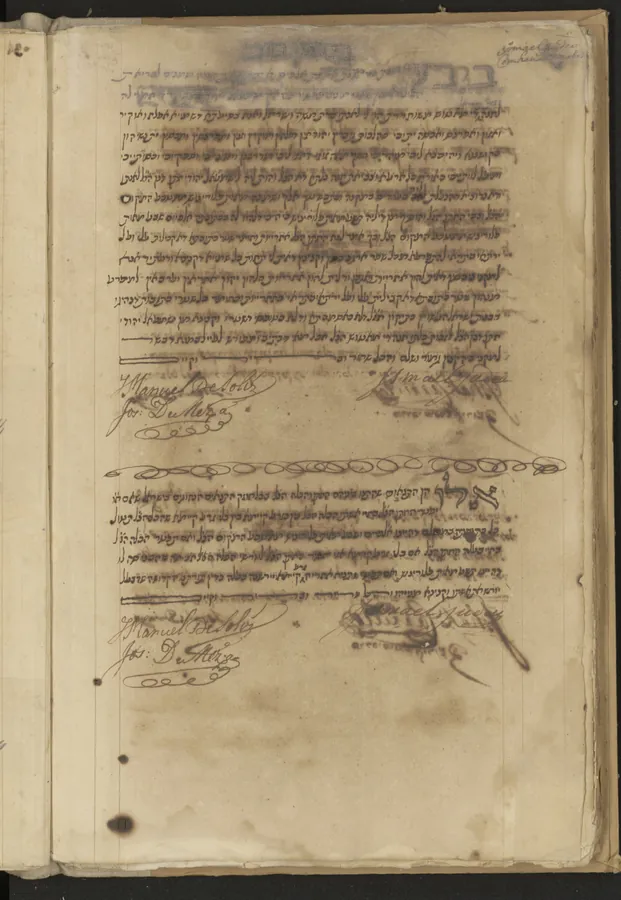
- Inquisition records — the trials of judaizantes are catalogued in the Archivo Histórico Nacional in Madrid and the Arquivo Nacional da Torre do Tombo in Lisbon, and many are digitised. They are painful reading, and they name names.
- «Limpieza de sangre» files — purity-of-blood investigations that were designed to expose New Christian ancestry, and now, ironically, document it.
- Notarial and emigration records — wills, dowries, and passenger lists tracing families to the Americas.
What DNA can add — and what it can't
A DNA test can flag genetic signals associated with Sephardic Jewish populations, and it can confirm that a family story has some basis. What it cannot do is prove that you are Jewish, name your ancestors, or establish eligibility for anything. Ethnicity estimates are statistical inferences, not certificates, and Iberian and Sephardic populations overlap heavily after five centuries of intermarriage. We go through this honestly on our Sephardic DNA testing page.
Putting it together
Treat this as a case built from several kinds of evidence: the family memory, the surnames, the region, the paper record, and the genetics. Any one of them can mislead. Together, they can turn a vague family rumour into something you can actually describe and document.
Our free at-home DNA kit is offered as one exploratory step in that process — a starting point, not a verdict.
Frequently asked questions
How do I know if I have Sephardic ancestry?
Look for a combination of signals: a converso-associated surname, a region with a documented converso population, unexplained family customs, and supporting records. DNA can add a further signal. No single clue is conclusive.
Is a surname enough to prove Sephardic ancestry?
No. Many surnames associated with conversos are also extremely common among families with no Jewish roots at all. A surname is a starting clue, not evidence.
Where do I find Inquisition records?
Chiefly the Archivo Histórico Nacional in Madrid and the Arquivo Nacional da Torre do Tombo in Lisbon; substantial portions are digitised and searchable online.
Does DNA prove I am Jewish?
No. Jewish status is a matter of religious law and documentation, not genetics. A DNA result is a research clue and nothing more.