The Alhambra Decree of 1492
The Alhambra Decree of 1492 expelled Spain's Jews and created the Sephardic diaspora and the Anusim. What the edict said, why it mattered, and its legacy today.
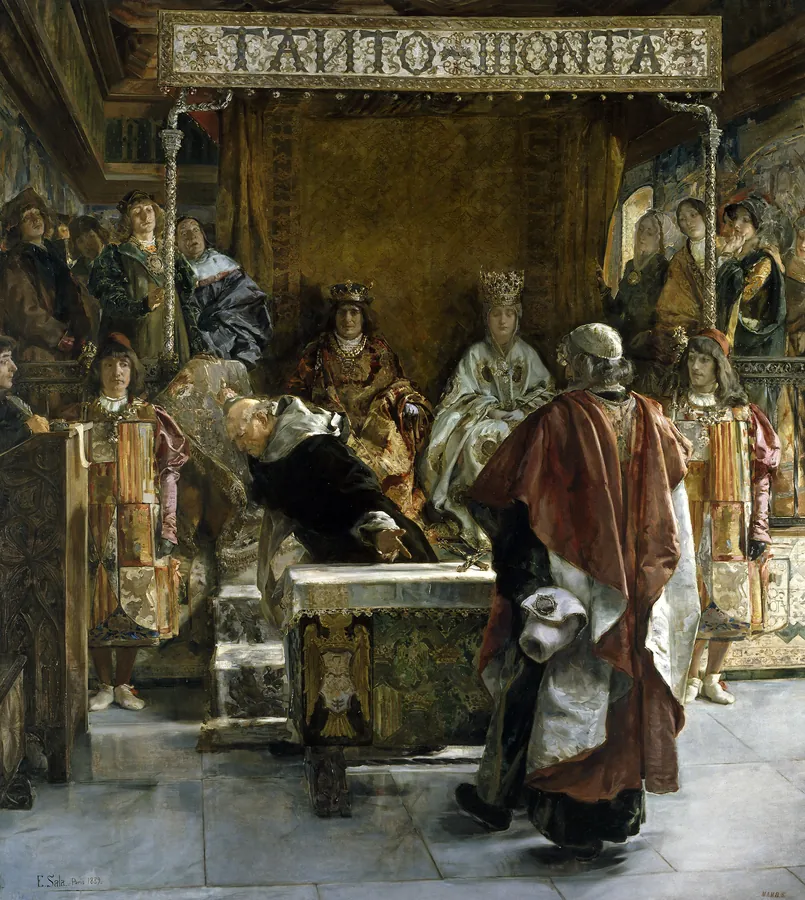
On 31 March 1492, in the freshly conquered Alhambra palace in Granada, Ferdinand and Isabella signed an edict giving the Jews of their kingdoms a few months to accept baptism or leave. It ended more than a thousand years of Jewish life in Spain — and created, in the same stroke, the crypto-Jewish world this project exists to trace.
What the decree said
The Edict of Expulsion, known today as the Alhambra Decree, ordered all Jews who would not convert to Christianity out of Castile and Aragon by the end of July 1492. They could take their movable property but not gold, silver, or coined money — which in practice meant selling homes and businesses at catastrophic prices in a market that knew exactly how little time they had.
Its stated justification was that Jews were leading conversos back to Judaism. That reasoning matters: the decree was aimed less at Jews as such than at severing New Christians from Jewish influence. Its author, in effect, was the Inquisition — the Grand Inquisitor Tomás de Torquemada had pressed hard for expulsion.
Why 1492?
The timing was not accidental. In January 1492, Granada fell, completing the Reconquista and leaving Ferdinand and Isabella masters of a unified Christian Spain. The Inquisition had been operating since 1478, hunting conversos suspected of Judaizing, and had concluded that its work was impossible while open Jewish communities remained. And the pattern was old: anti-Jewish riots in 1391 had already devastated Iberian Jewry and driven the first mass wave of conversions.
How many left
Nobody knows, and honest historians say so. Older accounts claimed 200,000 or more; modern scholarship has revised the figures downward substantially, with estimates commonly ranging from around 40,000 to over 100,000 departures — and there is no consensus. What is clearer is that a very large number chose baptism over exile, joining the converso population already created in 1391. Some who left later returned and converted in order to come home.
Where they went
The exiles went to Portugal (a decision that bought them only five years), to North Africa, to Italy, and above all to the Ottoman Empire, where Sultan Bayezid II received them and where Salonica and Istanbul became the great centres of the Sephardic world. Later generations reached Amsterdam, London, and the Americas.
Portugal, 1497
Portugal's answer was crueller in its way. Rather than expel a population that now included tens of thousands of Spanish refugees, King Manuel I ordered a forced mass conversion in 1497 — baptising an entire community, often violently, while largely preventing them from leaving. Portugal thereby produced New Christians on a national scale, which is why so many ordinary Portuguese surnames appear among families of converso descent.
The long afterlife
The decree was never enforced after the sixteenth century in any practical sense, but it remained formally on the books for centuries; Spain revoked it formally only in 1968. In 2015 Spain went further and offered citizenship to Sephardic descendants, and Portugal passed a comparable law — routes that have since closed or narrowed. Five hundred years on, the families created by 1492 and 1497 are still working out who they are.
Frequently asked questions
What was the Alhambra Decree?
The edict signed by Ferdinand and Isabella on 31 March 1492 ordering the Jews of Castile and Aragon to convert to Christianity or leave Spain by the end of July that year.
Why were the Jews expelled from Spain in 1492?
The stated reason was that Jews were drawing conversos back to Judaism. It followed the fall of Granada and years of pressure from the Inquisition, which regarded open Jewish communities as an obstacle to its work.
How many Jews were expelled from Spain?
Estimates vary widely and there is no scholarly consensus. Older figures of 200,000 or more have been revised downward, with modern estimates commonly ranging from roughly 40,000 to over 100,000.
When was the Alhambra Decree revoked?
Formally in 1968, though it had long ceased to have practical effect.
What happened in Portugal in 1497?
Rather than expel its Jews, Portugal under King Manuel I ordered a forced mass conversion, turning virtually the entire Jewish population into New Christians while largely preventing emigration.